
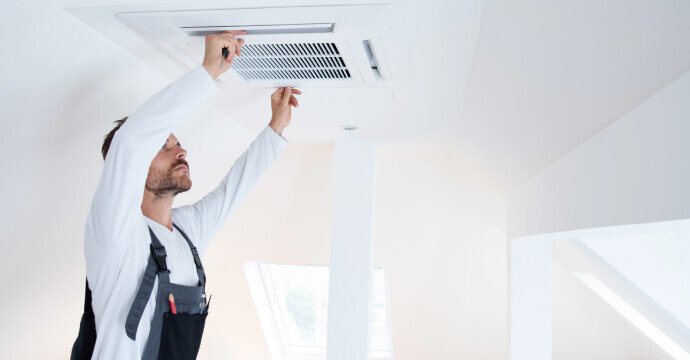
Choosing a Location for an Inverter Air Conditioner
When choosing the location, installers start from the specific model of climate-control equipment, discuss every question with the customer, propose solutions, and explain the reasoning behind their decisions. Several points are important here:
-
The indoor unit must not sit flush against the ceiling (the minimum clearance between the surfaces should be 10 cm, with at least 2 m from the floor to the air conditioner). The outdoor unit is best mounted in an easily accessible spot — near a window, for example — so that it can be reached when needed without calling in a bucket truck.
-
A wall with a window works well for the indoor unit. The distance to the outdoor unit should not exceed 5 m. The indoor unit is mounted higher up, with an outward tilt angle of 3 to 5°. This allows condensate to drain freely through the tube. With the indoor unit installed correctly, leaks and other problems are ruled out.
-
A single opening is provided for the drain tube and the refrigerant line.
-
The thickness of the wall between the units (outdoor and indoor) should not exceed 80 cm
-
With a quality inverter installation, the installer connects the system using the plug and the standard cable supplied by the manufacturer.
-
Plastic trunking can be used to conceal the line set and wiring.
Inverter air conditioners are quiet, so the indoor unit can be installed even in a bedroom. The main thing is to avoid strong air currents and drafts, which would interfere with the operation of the climate-control equipment.
A kitchen, being a room prone to sharp temperature swings, is not suitable for an inverter unit, as the appliance would have to run at elevated power.
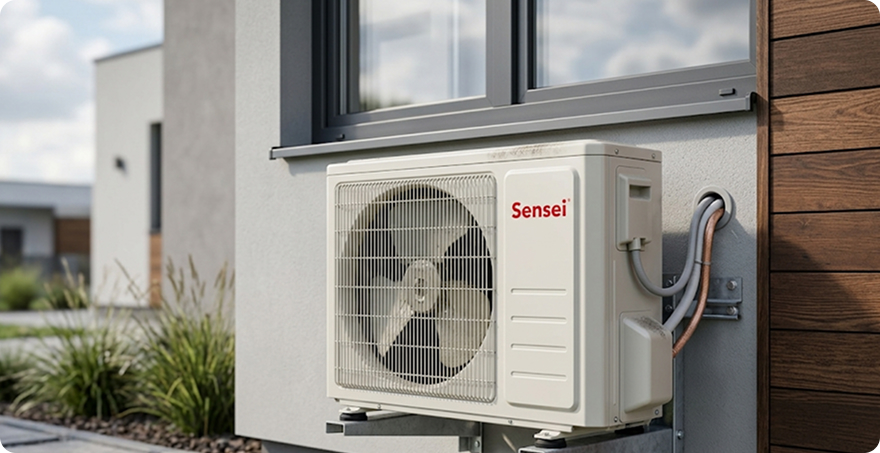
A standard inverter air conditioner installation takes about 4 hours. Non-standard cases require more time — and sometimes the services of industrial climbers or a bucket truck.
During construction or renovation work, a two-stage installation of an inverter air conditioner is used. First, the power cable, drain tube, and refrigerant line are routed (sometimes the outdoor unit is mounted as well). The indoor unit is installed once the construction and renovation work is finished. This approach is chosen by homeowners who prefer concealed routing of the inter-unit lines.
Installing the Outdoor Unit Correctly
When installing the outdoor unit, a number of factors are taken into account, the main ones being:
-
protection from weather conditions, vandalism, and other negative external influences;
-
unobstructed access to the parts of the split system;
-
the material and structure of the wall chosen for mounting the equipment;
-
obstacles that interfere with the natural movement of air;
-
the orientation of the wall relative to the sun.
And, of course, the weight of the climate-control equipment to be secured.
Proper Installation of the Indoor Unit
When installing the indoor unit, it is important to consider:
-
the presence and location of nearby heat sources;
-
an unobstructed airflow path — and one that does not blow directly on people.
Professionals choose copper tubing for the line set. It does not develop microcracks, which rules out refrigerant leaks — a common problem with cheap tubing. Heavy-duty reinforced tubing is used for the drain line as well. An industrial vacuum cleaner is used when chasing channels into the wall, keeping the installation work clean.
An inverter air conditioner is a serious rival to modern heaters — but only when it is installed competently by technicians who have done the job many times, hold the appropriate qualifications, have extensive experience and all the necessary tools, and provide a warranty on the quality of their work.