
An air conditioner can be bought anywhere, and its installation entrusted to a seasonal crew or builders
Don't rush off hunting for discount deals at non-specialized stores. That approach can certainly save you 10-15% on the equipment purchase — but who is going to install it?
Turning to "jack-of-all-trades" professionals (that is, in reality, non-professionals) can end in losses. At the installation stage, the lack of skills, specialized tools, and an understanding of how to select components will make quality work impossible.
The consequences of improper installation may surface immediately — or only after the warranty period offered by the firm has expired. Such non-specialized companies don't stay in business long. A year later, there may be no one left to file a claim against.
Sensei specialists have been selling and installing air conditioning equipment since 2006. Customers who come to us are guaranteed expert advice on choosing a model, professional installation, and support throughout the entire service life.
Important! When choosing a company that sells and installs air conditioning systems, ask its representatives to show their documents. The firm must provide a license for the work and certificates for the equipment. Don't forget to sign a contract with a sales receipt and a detailed list of the services provided.
One split system is enough to cool the whole apartment
Unfortunately, this is a mistake. Cooling several rooms evenly at the same time is a job only for expensive multi-zone or ducted systems, which will set you back $2-4K. Standard split systems call for a separate indoor unit in each room. And it is important not to miscalculate the split system's capacity — the correctness of its operation and the comfort of the resulting indoor climate depend on it.
Once the finishing work is done, you can say goodbye to the dream of blending the air conditioner seamlessly into the interior
Indeed, routing the refrigerant line and electrical cables at the early stages of renovation (before plastering and finishing the walls) is by far the smartest option. In that case, the channels for the lines do not spoil the look of the room.
However, if that moment has been missed, it is no disaster. The wiring and the refrigerant line can be run along the wall, with the unsightly elements concealed behind decorative modular trunking made of practical plastic.
Buying identical air conditioners for rooms of different sizes is a great way to give the apartment a unified look
Buying several units of the same model for an apartment or house at once is not the best idea. A system must be selected for each room individually, based on a whole set of parameters. You need to account for the size of the room, the presence of heat-generating appliances (microwaves, TVs, PCs, etc.), and the amount of heat coming in from outside (which depends on the floor and whether the windows face the sunny or the shaded side).
Sensei specialists recommend turning to professionals for the capacity calculation. Mistakes made in a do-it-yourself calculation will come back to haunt you more than once.
It doesn't matter where the indoor unit goes. Let's hang it wherever it's convenient!
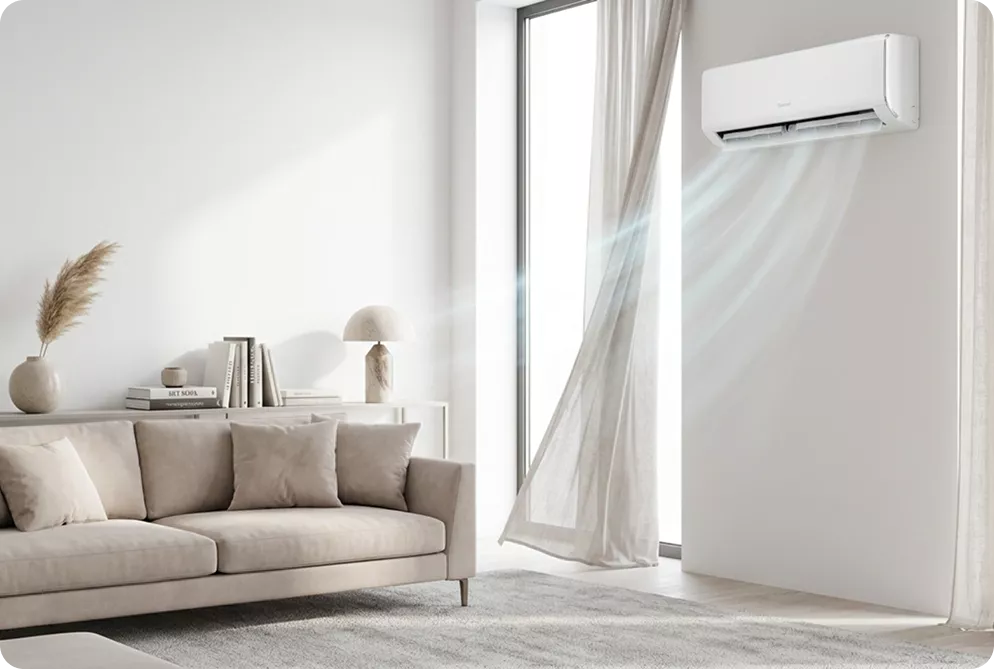
Practical instinct suggests placing the indoor unit where the coolness is needed most: above the sofa or the bed. It feels pleasant (the breeze from the fan washes over your face) and economical (no electricity wasted on cooling the entire space).
This is the wrong path. A stream of cold air aimed straight at your face and head can cause hypothermia and colds.
When choosing a spot for the indoor unit, let the installers know where you plan to place your relaxation areas.
Once the air conditioner is installed, there's no need to air out the room — the unit will handle it by itself.
The notion that an air conditioning system draws in outside air while expelling heated air outdoors is a widespread myth — it is true only in particular cases. Only cassette and ducted systems used in commercial and public buildings work that way. Another exception is monoblock air conditioners built into window openings.
Split systems, however, are designed differently. The air in them circulates in a closed loop and is not diluted with fresh outside air. That is why it is important not to forget about ventilation. It protects against mold growth and the emergence of breeding grounds for pathogens.