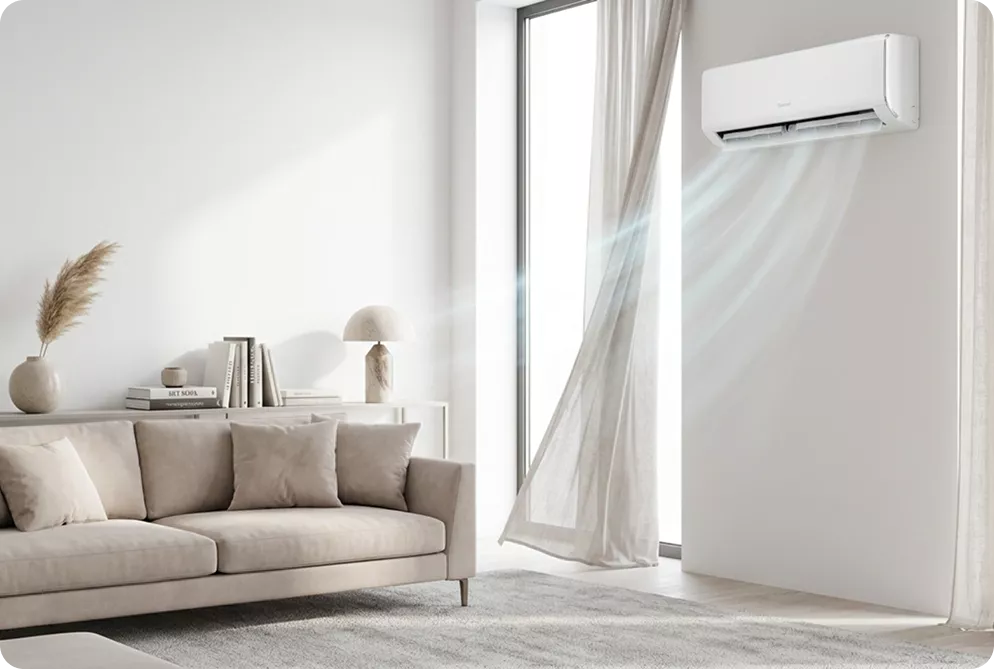
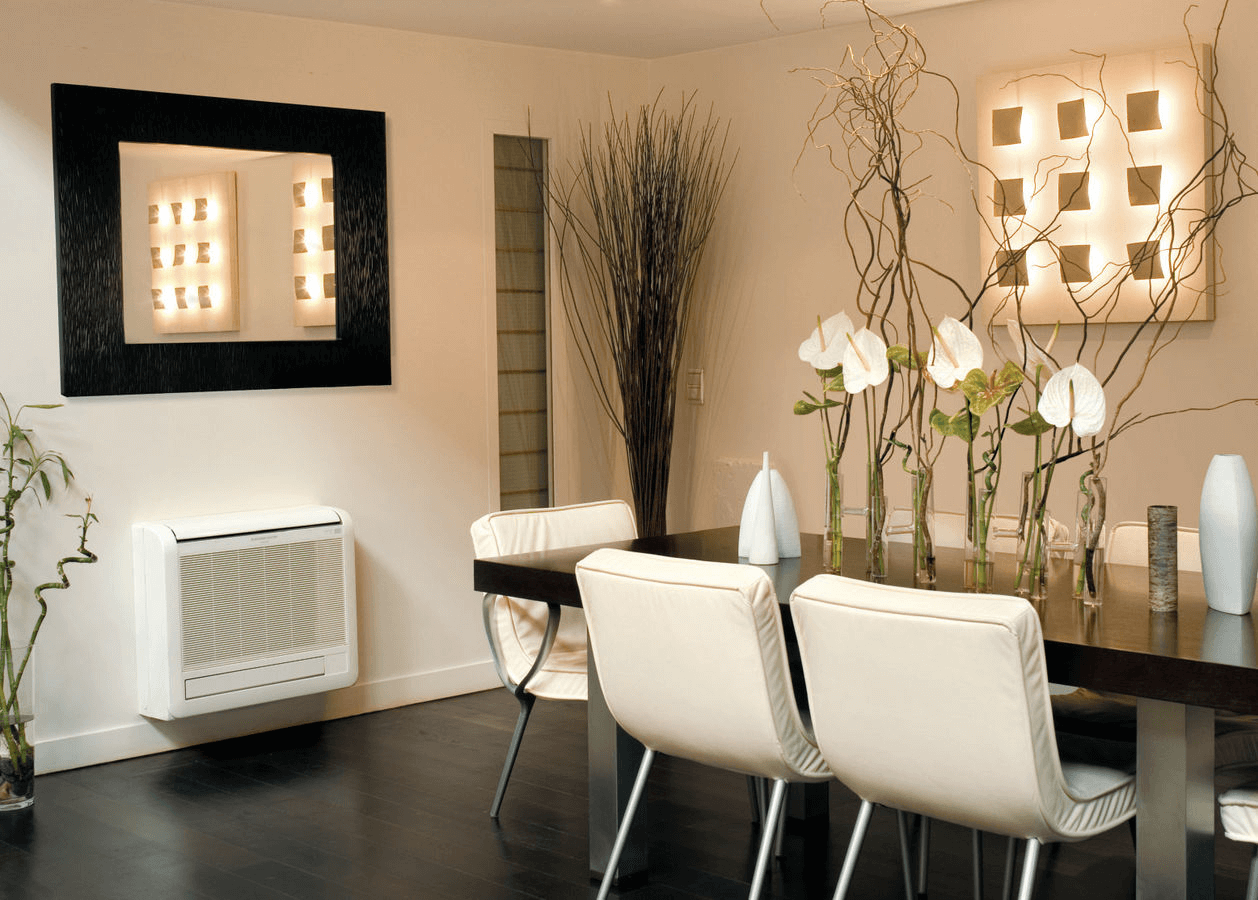
Key Features of Floor-Ceiling Air Conditioners
Like other split systems, this air conditioner consists of an outdoor and an indoor unit. The first includes the condenser, compressor assembly, capillary tube, filter-drier, service valve, and fan. It is designed for installation outside the premises. The indoor unit consists of an automated control system, indicator panel, filter elements, motor, louvers, and a condensate tray. The shape of the indoor unit allows the equipment to be positioned not only with various mounting options but also installed on virtually any surface — on the ceiling, the floor, or in recesses.
Placing the equipment at floor or ceiling level produces stable, gradual air distribution — no drafts or blasts of scorching air. Floor-ceiling air conditioners also belong to the semi-professional equipment category and offer far higher capacities than conventional air conditioners.
SENSEI specialists highlight the following advantages of floor-ceiling climate systems:
- installation convenience — flexibility in where the indoor unit is mounted;
- even air distribution;
- compactness — a floor-ceiling system takes up minimal space;
- low power consumption relative to output;
- a range of filters, including ones with antibacterial protection;
- flexible adjustment of the heat flow via the automatic control system.
Applications of Floor-Ceiling Air Conditioners
The placement of this type of climate-control equipment is determined by the characteristics of the specific room: its area, the geometry of its corners, and its layout. At the same time, the versatility of floor-ceiling air conditioners allows them to be installed to suit any design concept. This type of air conditioner is indispensable in rooms unsuited to standard climate-system configurations.
SENSEI specialists recommend floor-ceiling air conditioners for the following situations:
- serving large spaces (stores, offices, and warehouses);
- the presence of "difficult" surfaces for installation work (glass or mirrored);
- rooms crowded with bulky industrial machinery.
Installing Floor-Ceiling Air Conditioning Systems
The outdoor unit is made of strong, durable materials, since it is regularly exposed to harsh conditions. Even so, positioning it correctly will not only extend the unit's service life but also prevent potential malfunctions.
SENSEI specialists have formulated the following rules for installing the outdoor unit:
- The outdoor unit should be placed only in open spaces.
- Choose a mounting location at the minimum possible distance from the indoor unit.
- To protect against snow and ice falling from the roof, and to shield the unit from strong gusts of wind, additional protective canopies or horizontal plates should be installed.
- A solid mounting surface ensures the equipment operates without vibration and the accompanying noise.
In addition, special requirements apply to the power supply system and to the system's mounting hardware (which must be sufficiently strong and reliably withstand the calculated loads). The technical parameters of the latter are described most precisely in the equipment's documentation.
Tips for Operating a Floor-Ceiling System
Proper care can extend the life of the equipment and spare the user unnecessary expenses and other troubles. For the climate system to deliver a comfortable indoor environment without interruption, a few simple steps need to be known and followed:
- rinse the filter at the prescribed intervals. How often depends on its type (carbon, mesh, etc.);
- top up the refrigerant — once a year before the start of the season;
- clean dust and debris from the heat exchangers — once a year.
For best results, it is advisable to entrust these procedures to professionals. Technicians will not only perform the maintenance carefully and expertly but also preserve the appliances in full working order (whereas an ordinary user can easily damage a critical structural component).